Understanding & Preventing Newton Rings
What Are Newton Rings?
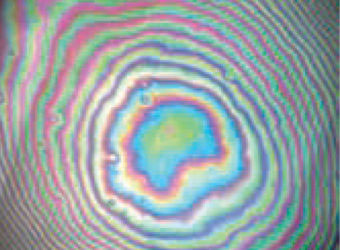
Newton rings are a phenomenon that can occur when light reflects between two surfaces: a convex lens and an adjacent flat surface. This effect, named after Sir Isaac Newton who first studied it, results in a series of concentric, alternating bright and dark rings. These rings are caused by the interference of light waves.
Sir Isaac Newton first documented this effect in 1704, in Proposition XII of his treatise “Opticks: A treatise of the reflexions, refractions, inflexions and colours of light.”
Read the Original Text →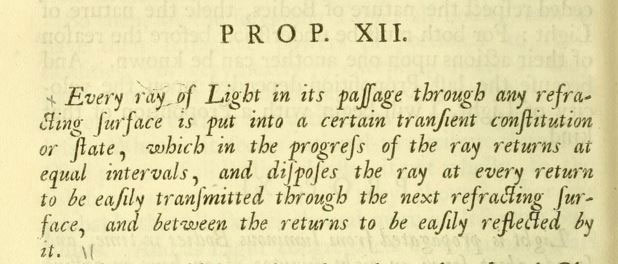
Thin-Film Interference
Thin-film interference is a natural phenomenon in which the combination of two or more electromagnetic waveforms forms a resultant wave in which the displacement is either reinforced or canceled.
Reflections & Phase Changes
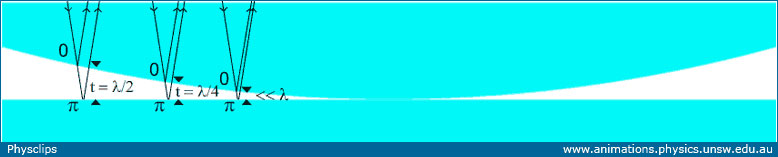
Consider the geometry close to the point of contact between the convex lens (top, or a pressed film) and the glass or plastic flat (bottom). Where the separation t between interfaces is less than a quarter wavelength, λ/4, two rays traveling upward have a phase difference from path length that is much less than π.
At the upper surface, the ray reflects going from glass or film towards air — high n to low n — so the phase change is zero. At the lower surface, the ray reflects going from air towards glass — low n to high — so the phase change is π. This gives destructive interference in reflection near the point of contact.
At a thickness of t = λ/4, the path difference is 2t = λ/2, giving a phase difference of π. Combined with the π from reflections, the total phase difference is 2π — the rays are back in phase, giving constructive interference in reflection.
At t = λ/2, the path difference is 2t = λ, giving a phase difference of 2π. Combined with the π from reflections, the rays are out of phase by one and a half cycles — destructive interference once again.
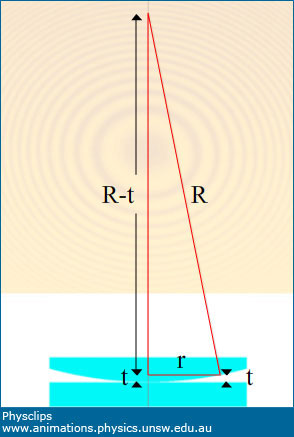
Since the air film has varying thickness, different interference conditions occur at different radii — producing the alternating bright and dark concentric rings.
Diagrams and physical descriptions presented courtesy of the UNSW School of Physics, Sydney, Australia.
Formation of Newton Rings
Newton rings are created when a thin air film exists between two surfaces, such as a lens and a glass plate. Here’s a step-by-step breakdown of the process:
-
1Thin Film Interference — When light waves hit the thin air film, they are partially reflected and partially transmitted at both the top and bottom surfaces of the film.
-
2Wave Interference — The reflected light waves interfere with each other. Depending on the thickness of the air film, this interference can be constructive (bright rings) or destructive (dark rings).
-
3Variable Thickness — The thickness of the air film varies radially from the point of contact outward, leading to the appearance of concentric rings.
The varying thickness of the air gap causes different wavelengths of light to interfere at different points, producing the characteristic pattern of Newton rings.

Problems Caused by Newton Rings
In various optical display applications, Newton rings can be problematic. They can obscure details, reduce image clarity, and create unwanted artifacts. For example, in photographic film scanning, Newton rings can appear as unwanted patterns that distort the scanned image.
Preventing Newton Rings
Anti-Newton Ring Coatings
ANR coatings are designed to prevent the formation of the air film that causes interference.
Microscopic Roughness
A microscopic surface texture prevents a uniform air film from forming, so any air gaps are too irregular to produce coherent interference patterns.
Reduced Reflection
Some ANR coatings reduce reflections by minimizing the amount of light reflected back into the lens, further reducing interference patterns.